
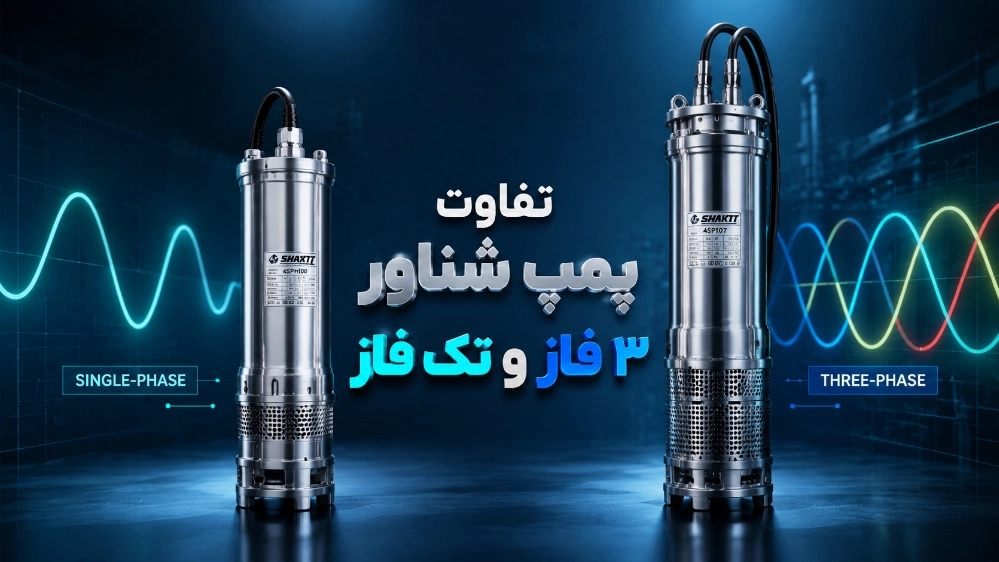
Choosing the right pump for the well is one of the most important decisions that can directly affect the performance of the water supply system, maintenance costs, electricity consumption and equipment life. Among the available options, many buyers and well operators are faced with the question of a 3-phase submersible pump is better or a single-phase submersible pump. The answer to this question depends on various factors such as the depth of the well, the volume of water required, the type of use, the existing electricity infrastructure and the initial budget.
If you make a purchase without knowing exactly, you may face problems such as pressure drop, increased depreciation, high energy consumption or even burning of the electric motor. For this reason, knowing the exact difference between a 3-phase and a single-phase submersible pump is absolutely necessary for anyone who intends to equip an agricultural, industrial or domestic well.
In this article, we will examine in a complete and specialized way what is the difference between 3-phase and single-phase submersible pumps, what are the advantages and limitations of each, what types of wells are they most suitable for, and finally how to make the best choice. Also, in different sections, we point out tips that will help you make a more accurate and economical decision when buying. In this direction, the experience and quality of reliable manufacturers are also very important, and Gasar Pump Industries, as one of the reliable groups in the field of producing and supplying all kinds of floating pumps, can be a safe choice for professional buyers.
What is a submersible pump and why is it important to choose its phase?
A submersible pump is a type of submersible pump that is completely submerged in water and is used to extract water from deep, semi-deep wells, reservoirs and underground sources. The design of these pumps is such that the electric motor and the pumping part work seamlessly in the water, which increases efficiency and reduces suction losses.
But at the time of purchase, it is not enough to pay attention to the pumping height or flow rate. One of the most important things is the choice between single-phase and 3-phase models. This choice is directly related to the type of electricity consumed, the required power and the working conditions of the pump. Simply put, if you don't choose the right phase according to the conditions of the well, even the best pump can't perform well.
The difference between 3-phase and single-phase submersible pump starts exactly from this point; That is, the type of electric power supply, how to start the engine, output power, work efficiency and type of application.
What is a single-phase submersible pump?
The single-phase submersible pump works with single-phase electricity; The same electricity that is commonly available in homes, small gardens, villas and many light uses. These types of pumps are usually designed for lower capacities and applications that do not require very high flow and pressure.
The single-phase submersible pump is widely used in small projects due to easier access to electricity. Installation of this type of pump is easier in many areas, and users usually do not need complex industrial electrical equipment to set it up. Of course, this simplicity comes with limitations in some situations.
In single-phase pumps, starting the motor is usually done using a capacitor. Although this issue provides good performance for light and medium use, it is more limited in heavy loads and long-term operations than 3-phase models.
What is a 3-phase submersible pump?
3-phase submersible pump uses three-phase electricity; Electricity that is mostly available in industrial environments, workshops, large farms, agricultural wells and heavy projects. These types of pumps are ideal for continuous operation, higher pressure, greater depth, and greater water volume.
3-phase motors naturally have a smoother, more uniform and more powerful start-up. For this reason, in situations where the well is deep or the volume of water extraction is high, using a 3-phase submersible pump will usually be more rational and economical. Many facility and agricultural experts believe that in professional applications, the difference between 3-phase and single-phase submersible pump is determined above all in the performance stability and real power of the motor.
The most important difference between 3-phase and single-phase submersible pump
For a better choice, it is necessary to examine the differences in a detailed and practical way. In the following, we review the main differences between these two types of pumps.
1. The difference in the type of electricity used
The first and most obvious difference is the type of electricity required. A single-phase pump works with normal city electricity, but a 3-phase pump requires industrial electricity. If your installation site only has access to single-phase power, your choices will naturally be more limited. But if the three-phase electricity infrastructure is available, your hand is more open to use more powerful pumps.
2. Difference in power and working capacity
In most cases, 3-phase pumps have higher power than single-phase models. These pumps are more suitable for transferring a large volume of water from a high depth. In contrast, single-phase pumps are used for more limited applications. Therefore, if your well is deep or used for extensive irrigation, livestock, factory or large complex, the advantage of 3 phases will be very noticeable.
3. The difference in efficiency and energy efficiency
One of the important points in examining the difference between 3-phase and single-phase submersible pumps is energy efficiency. 3-phase motors are usually more efficient and convert electrical energy into mechanical energy with less loss. This issue is very important in continuous and long-term use, because it can reduce operating costs.
4. Difference in engine start and performance
A single-phase motor depends on components such as capacitors to start and may be overstressed under certain conditions, especially during voltage drops. But the 3-phase motor has a smoother and more stable start-up. This feature reduces the mechanical and electrical stress on the pump components, and as a result, the useful life of the device increases.
5. Difference in initial cost and infrastructure
A single-phase pump usually has a lower initial cost and is easier to install. But the 3-phase pump, in addition to the higher price, may require a suitable electrical panel, more specialized cabling and industrial infrastructure. However, in large projects, this initial cost is compensated in the long run by better efficiency and lower depreciation.
6. Differences in application
The use of single-phase pump is mostly seen in villas, residential units, small gardens, shallow wells and semi-light uses. On the other hand, the 3-phase pump is mostly used in large agricultural fields, deep wells, factories, construction projects and industrial systems.
Advantages of single phase submersible pump
In spite of its limitations, the single-phase submersible pump is a perfect choice in many projects. Among its most important advantages, the following can be mentioned:
Easy access to electricity
The biggest advantage of a single-phase pump is that in most areas, the electricity it needs is easily available. This feature makes it a simple and practical choice for home users and small gardeners.
Easier installation
Setting up a single-phase pump is usually less complicated compared to a 3-phase model. As a result, installation costs, peripheral equipment and preparation time are reduced.
Suitable for light and medium use
If your well is not very deep and the amount of water withdrawal is normal, the single-phase pump can provide satisfactory performance.
Lower initial cost
For those who are looking for cost control at the beginning of the journey, a single-phase pump can be a more economical option.
Advantages of 3-phase submersible pump
When the working conditions become heavier, the advantages of the 3-phase pump show themselves more. These benefits include:
Higher pumping power
3-phase pumps are very suitable for deep wells and high flow rates due to having stronger motors.
Uniform and stable performance
Three-phase electric current makes the motor work with less fluctuation and better performance quality. This issue is very important in continuous use.
Better efficiency in the long run
If the pump is used daily and in large volume, the higher efficiency of 3 phases can lead to significant savings in operating costs.
Less depreciation in professional conditions
In industrial and agricultural applications, the greater stability of the 3-phase motor reduces breakdowns and increases the useful life of the equipment.
Which one is best for your well?
The answer to this question depends on the actual conditions of your project. If we want to make a practical and accurate decision, we must check several main factors.
The depth of the well
The deeper the well, the more power and head you will need. In deep wells, a 3-phase submersible pump is usually a safer choice. But in shallow or semi-deep wells, the single-phase model can also be the answer.
The amount of watering required
If you need a small amount of water for household or garden use, a single-phase pump is sufficient. But if you have extensive irrigation, industrial consumption or continuous harvesting, it is better to go for the 3-phase model.
Type of electricity on site
Sometimes your choice depends more on the electrical infrastructure than anything else. If 3-phase power is not available locally and is difficult to obtain, a single-phase pump would be a more practical choice. But if three-phase electricity is available, you should take seriously the technical advantages of the 3-phase model.
The duration of pump operation
For short-term or discontinuous operation, a single-phase pump is a suitable option. But for long, daily and continuous operations, the 3-phase pump has better durability and efficiency.
Initial budget and long-term cost
Sometimes the buyer only cares about the purchase price, while the cost of electricity, repairs, depreciation and efficiency should also be considered. In many large projects, although the initial cost of 3 phases is higher, it will be a more economical choice in the long run.
Common mistakes in choosing a submersible pump
In examining the difference between 3-phase and single-phase submersible pump, you should also pay attention to the common mistakes of buyers. One of the common mistakes is to make a decision based only on the availability of electricity, without having calculated the actual need of the well. Another mistake is choosing a pump with less power than needed, which causes excessive pressure to the engine and reduces the life of the device.
Also, some people just go for the cheaper option regardless of the build quality. On the face of it, this decision is economical, but in practice it can lead to higher costs in terms of failure, performance loss and early replacement. For this reason, choosing a reliable manufacturer is very important.
Why is brand quality important in choosing a pump?
It doesn't matter whether you intend to buy a single-phase or 3-phase submersible pump; In both cases, the quality of construction, hydraulic design, material of parts, assembly standard and technical services play a decisive role in your final satisfaction. A low-quality pump, even if it is suitable in terms of technical specifications on paper, may not perform optimally in practice due to loss of efficiency or premature failure.
Meanwhile, Gazar Pump Manufacturers Industries as a specialized group in the field of production and supply of all types of floating pumps, relying on the quality of construction, technical experience and accurate understanding of market needs, has been able to gain a significant position among buyers and activists in this field. If you are looking for a product that is both reliable in terms of technical performance and provides good durability in real working conditions, Gasar Pump Industries products can be a reliable option for various projects.
The role of expert advice in choosing the right pump
One of the most important steps to take before buying is to get expert advice. Choosing the correct pump is not done only by knowing whether it is single-phase or 3-phase. Specifications such as installation depth, pumping height, required flow rate, well diameter, water quality, type of use and duration of operation should be checked.
Collections that have a detailed technical understanding of these parameters can avoid costly mistakes. Gazar Pump Industries with experience in the field of submersible pumps and familiarity with the various needs of customers, can play an effective role in making the right choice. This issue is especially important for buyers who are hesitating between several models.
summary
If we want to have a clear conclusion, we must say that the difference between 3-phase and single-phase submersible pump is not limited only to the type of electricity consumed. This difference includes a set of factors such as engine power, pumping capacity, efficiency, durability, type of application, and short-term and long-term costs.
The single-phase pump is a suitable choice for lighter applications, places with limited access to industrial electricity and projects with a lower initial budget. On the other hand, the 3-phase pump is considered a superior option for deep wells, heavy usage, continuous use and projects that require professional performance.
Therefore, to know which model is more suitable for your well, you should carefully check the actual conditions of the project. If this choice is made based on technical analysis and the use of high-quality products, not only the performance of the water supply system will be better, but also future additional costs will be avoided.
In this way, choosing a reliable manufacturer is particularly important. Gazar Pump Manufacturers Industries can be a reliable partner for buyers who care about quality, durability and professional performance by providing specialized solutions and reliable products in the field of submersible pumps. If your goal is to make a smart and lasting choice to equip the well, paying attention to product quality and expert advice is the point where the success of your project begins.